

Best Travel Nurse Housing in Florida: Nursing Rental Sites & Insider Tips

In this article
- What Every Travel Nurse MUST Know About Housing in Florida
- How Housing Choices Affect Your Real Take-Home Pay
- How Much Does It Cost to Live in Florida Per Month?
- 5 Types of Short-Term Housing for Travel Nurses in Florida
- Travel Nurse Housing in Miami: Costs, Tips & Top Areas
- Travel Nurse Housing in Orlando: Costs, Tips & Top Areas
- Travel Nurse Housing in Tampa: Costs, Tips & Top Areas
- Travel Nurse Housing in Jacksonville: Costs, Tips & Top Areas
- Regional Housing Cost Breakdown for Travel Nurses in Florida
- Where to Find Short-Term & Furnished Rentals in Florida
- Can You Get Around Florida Without a Car?
- Safety First: Florida-Specific Housing Tips
- A Travel Nurse Agency That Truly Cares
- FAQs for Travel Nurse Housing in Florida
Florida is one of the best places to take a travel nurse assignment—where else can you mix world-class healthcare experience with beaches, theme parks, and sunshine? But finding the right housing can make or break your contract. From seasonal rent changes to furnished rentals and stipend strategies, there’s a lot to consider before you pack your bags.
That’s why we’ve put together this guide. Inside, you’ll find real tips tailored for travel nurse housing in Florida, including:
- Where to find short-term housing for travel nurses
- When furnished rentals for travel nurses are worth it
- How to stretch your travel nurse housing stipend in Florida
- Transportation tips
- Key lease and deposit rules in Florida
- Best neighborhoods for commute, safety, and value
Whether you’re setting off for your first travel nursing job in Florida or returning for another assignment, these insights will help you feel prepared to find travel nurse housing in Florida.
What Every Travel Nurse MUST Know About Housing in Florida
Florida’s rental market has its own set of challenges that go beyond just rent prices. For travel nurses, finding housing isn’t just about having a place to sleep; it’s about securing a safe, comfortable home that fits within your stipend and supports you during your contract. From hurricane season to fluctuating rental rates, there are important factors to consider before signing a lease.
Hurricane Season & Lease Clauses
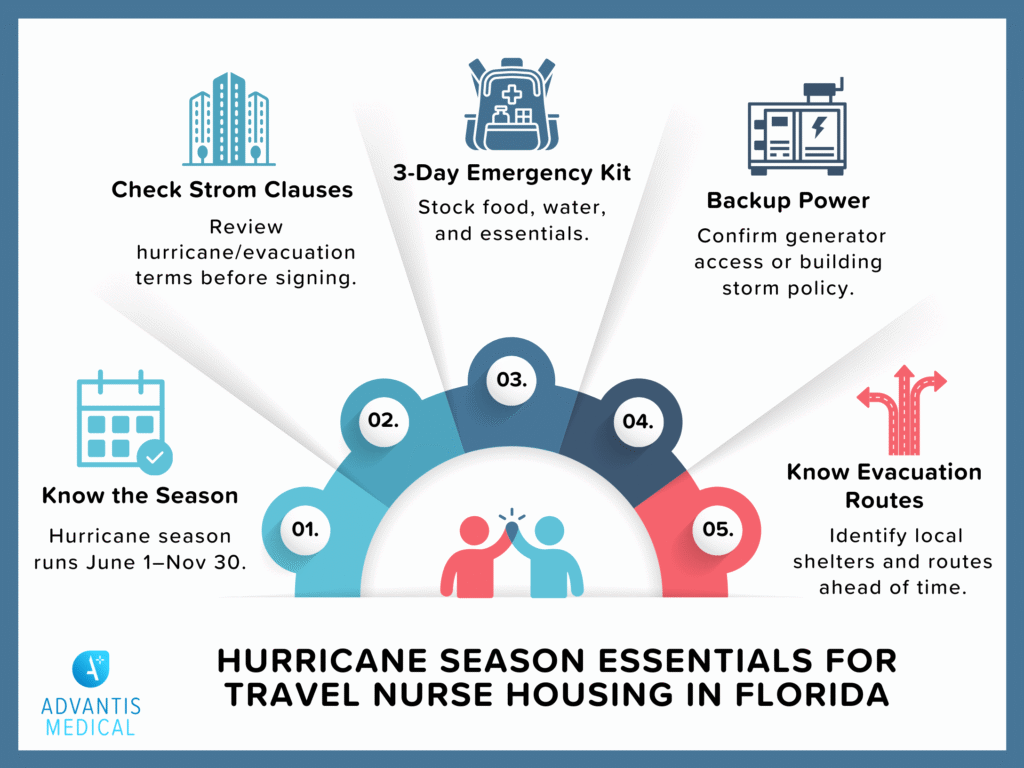
Florida’s official hurricane season runs from June through November (National Hurricane Center). Many coastal leases include hurricane clauses, which outline both the landlord’s and tenant’s responsibilities in the event of a mandatory evacuation or property damage. Make sure to read this section carefully before signing any agreement.
If you’ll be living near the coast, ask about storm shutters, impact glass, and back-up power. These features can make a difference in your safety and comfort during severe weather. Florida’s Disaster Hub is a great resource to help you prepare. Always plan to have an emergency kit with food, water and supplies to last at least 3 days. If possible, consider having access to a generator. If it all feels overwhelming, lean on your recruiter for guidance and don’t be afraid to ask your new neighbors for advice, locals are usually happy to share their experience.
Understanding Florida’s Security Deposit Rules
While Florida law doesn’t cap the amount a landlord can request for a deposit, it does require landlords to hold the deposit in a separate bank account and provide tenants with written notice of where it’s being held within 30 days. The typical market practice is around one month’s rent. For complete details, see Florida Statutes §83.49. Knowing your rights helps you avoid surprises and ensures your deposit is handled properly.
Tourist Season Pricing
Seasonal demand plays a big role in Florida rental costs for travel nurse housing. From November through April, “snowbird” season brings a large influx of part-time residents, while spring break crowds fill the beaches from March into April. During these peak months, rental prices in popular areas can increase by 20% to 50%. Expect higher short-term rates in hot spots like Miami, Tampa Bay, Orlando and Southwest Florida, especially near beaches and theme parks. Plan ahead and book early to avoid higher rates.
Utilities
Unlike colder states, air conditioning—not heating—is what drives utility bills in Florida. As of 2025, the average residential electric bill is between $130 and $175 per month (Florida Power & Light), with higher costs during the summer heat. Climate varies across the state—South Florida is hotter than the Panhandle—so usage may depend on your location. To save money, consider smaller housing, seek Energy-Star rated appliances, and monitor your A/C use closely (Energy Star).
Furnished vs. Unfurnished Options
Furnished rentals for travel nurse housing in Florida are common near hospitals and tourist areas, but they can cost more than comparable unfurnished units. In suburban or rural areas, you’ll see more unfurnished options. The trade-off is convenience—furnished housing lets you move in quickly and travel light, while unfurnished rentals may save you money if you’re staying longer or already have your own setup.
Lease Flexibility
Lease terms for travel nurse housing in Florida vary across the state. Near major medical centers, short-term options (30–90 days) are more common, perfect for travel nurses. However, larger apartment complexes often prefer leases of 7 to 12 months, which may not align with your assignment length. That’s where the Advantis Medical housing team can help—they know which landlords and properties are flexible, saving you time and stress.
How Housing Choices Affect Your Real Take-Home Pay
For travel nurses, housing is usually the biggest expense, and in Florida, the wrong choice can quickly eat into your paycheck. Smart housing choices not only keep you comfortable but also determine how much of your stipend you get to keep in your pocket.
Florida Cost-of-Living Snapshot (Index vs. U.S.=100)
Florida sits just above the national cost-of-living average, but costs vary alot depending on the city and season. Here’s how the numbers break down, according to MERIC Cost of Living Data Series, 2025:
| Category | Florida Index (Q2 2025) | What It Means for You |
| Overall | 102 | Slightly above the U.S. average |
| Housing | 106 | Higher rents in major metro areas |
| Health | 90 | Slightly lower than the national average |
| Groceries | 105 | Costs vary by metro, slightly above average |
| Utilities | 99 | Manageable, but A/C drives summer bills |
So Florida is generally affordable for travel nurse housing but costs in more expensive places like Miami, Tampa and Orlando can eat into your take-home pay.
How Much Does It Cost to Live in Florida Per Month?
To put it in perspective, let’s say your travel nurse stipend is $3,800 per month. If you find a furnished rental for $2,100 you can pocket the additional $1,700 tax-free every month. Over the course of a 13 week contract (about 3 months) that’s an extra $5,100 in net savings without picking up extra shifts.
Your actual living expenses in Florida may look something like this:
- Average statewide rent (2025): $2,400 (Zillow)
- Electric bill: $135–$175 per month
- Gasoline: ~$3 per gallon (AAA Gas Prices)
- Public transit: $35–$145 for a monthly pass, depending on the city
Choosing the right short-term housing for travel nurses can make a big difference in how much of your stipend you retain.
5 Types of Short-Term Housing for Travel Nurses in Florida
Finding the right short-term housing for travel nurses is about balancing cost, comfort and convenience. Here are the 5 most common options:
House/Townhouse
A house or townhouse has plenty of space, privacy and usually has a yard or outdoor area. This can be a big improvement over a small apartment, perfect for travel nurses with pets or anyone who likes a quieter place to live.
- Pros: More space, privacy and a real “home away from home” feel.
- Cons: Can be more expensive and may require longer lease commitments. Utilities might not be included and you’ll have more responsibilities like lawn care.
- Best For: Long term assignments, nurses traveling with family or pets and those who prioritize a residential feel.
Apartment/Condo
The most popular choice for travel nurse housing. Apartments and condos offer the perfect balance of comfort and affordability. Furnished options are widely available and many complexes offer amenities like gyms and pools.
- Pros: Good amenities, lower maintenance and a variety of locations.
- Cons: Less privacy than a house and can have complex application processes.
- Best For: Travel nurses looking for a balance of amenities, cost and sense of community.
Shared Living
For the budget conscious traveler, renting a room in a shared living space is the most cost effective housing option. It’s also a great way to meet other professionals or locals in your new city.
- Pros: The most budget friendly option, utilities often included in the rent.
- Cons: Lack of privacy, shared spaces can be a challenge after a long shift and potential for personality conflicts.
- Best For: Short assignments or those who want to save big on their housing and enjoy a social living environment.
Extended-Stay Hotels
This is the ultimate turnkey solution for short-term housing for travel nurses. Extended-stay hotels are flexible, require no long-term lease, and include all utilities and amenities. Most are fully equipped with a kitchen, making them a good option for a brief stay.
- Pros: All-inclusive, immediate availability, and no lease commitments.
- Cons: Can be pricier than a traditional short-term rental and lacks the personal touch of a home.
- Best For: Last-minute assignments, first-time travelers, or as a temporary solution while you look for a longer-term rental.
Furnished Rentals
One of the most popular housing options is furnished rentals for travel nurses. This option takes away the stress of buying, renting, or moving furniture. Everything is ready for you, from furniture to kitchenware, saving you time and effort.
- Pros: Ready to move in, no furniture costs, utilities are often included, and flexible lease terms are perfect for 13-week contracts.
- Cons: Higher upfront cost compared to unfurnished options, and availability can be limited in specific markets.
- Best For: All travel nurses, especially those on a standard 13-week contract, who want maximum convenience and minimal hassle while maximizing their stipend.
Tip: Explore travel nurse housing websites and get support from the Advantis Medical housing team to secure the best fit. Using both resources helps confirm landlord credibility, check amenities, and compare commute times before you commit.
- Highest-paying states and cities, ranked from live contracts
- Take-home pay and tax considerations
Travel Nurse Housing in Miami: Costs, Tips & Top Areas
Miami is a great city for travel nurses, you can work at world class healthcare facilities while enjoying the city’s Cuban culture, nightlife and year round sunshine. But with this comes some of the highest rental costs for travel nurse housing in Florida. Short term rentals for travel nurses near neighborhoods like Coral Gables or Little Havana may provide slightly better deals than downtown, but expect a premium around major hospitals. As of July 2025 the average rent across the city is about $2,700 (RentCafe).
Neighborhoods to Target
- Brickell – Known for luxury high-rises, Brickell offers easy access to Metrorail and Metromover, plus walkability to Brickell City Centre.
- Wynwood/Edgewater – Creative, artsy vibe with close proximity to Jackson Health and UM.
- Little Havana – More budget-friendly, great food scene, and a quick drive to Miami.
- Suburban Value (Kendall & Doral) – Modern units, more parking, and less traffic than the urban core. Good for travel nurses who want space and affordability.
Commute and Parking Tips
Public transportation is the way to avoid Miami traffic. Metrorail, Metromover and bus systems help you avoid I-95 and US-1. If you plan to drive, keep in mind downtown garage parking adds up quickly so factor that into your stipend planning. For routes, schedules and updates visit the Miami-Dade Transit website.
Search Smart
When looking for travel nurse housing in Florida don’t rely on just one source. Use Furnished Finder, Airbnb and Zillow to cross check pricing, availability and landlord credibility.
Travel Nurse Housing in Orlando: Costs, Tips & Top Areas
Orlando is known for Disney’s Magic Kingdom, Universal Studios and theme park magic but it’s also a growing hub for healthcare. Major employers like Orlando Health, AdventHealth and specialty centers keep demand for travel nurse housing steady year round. With entertainment, culture and career opportunities all in one place Orlando is one of Florida’s most popular destinations for travel nurses. The average citywide rent in 2025 is about $1,800 (RentCafe).
Neighborhood Snapshots
- Baldwin Park (~$2,500): A planned community with lakefront walking paths, town-center retail and newer housing stock.
- Lake Formosa (~$2,300): Home to art museums and close to downtown, offers culture and convenience.
- Downtown Orlando (~$1,800): The city’s core, blending high-rise apartments with historic homes. Good for nurses working at Orlando Health or AdventHealth Orlando.
- Budget-Friendly Picks: Rosemont ($1,500) and Signal Hill ($1,400) offer more affordable rent options while still having access to the city’s main corridors.
(Source: RentCafe)
Transit and Commute
Orlando’s traffic can be time-consuming, particularly around I-4 and the theme parks, so choosing the right location can save both time and money. Look for housing that’s close to your facility or near highways that provide direct routes around congested areas.
Public transit is a great way to avoid traffic. The LYNX bus system (GoLynx) and SunRail commuter train (SunRail) can help cut car costs while still providing a reliable commute. If you do drive, consider apartments or complexes with bundled parking and easy access to SR-408 or I-4 for smoother connections across the city.
Travel Nurse Housing in Tampa: Costs, Tips & Top Areas
Tampa has become a major healthcare hub on Florida’s Gulf Coast making it a favorite for travel nurses. With top facilities like South Tampa Hospital and Kindred Hospital Central Tampa the city offers great opportunities for travel nursing. Tampa’s housing market fluctuates with the season with prices rising during peak tourist season.
As of 2025, the average rent for a one-bedroom apartment in Tampa is around $2,000 per month with furnished options for travel nurses running higher depending on location, amenities and proximity to medical centers (RentCafe).
Neighborhood Snapshots
- Downtown (~$3,000): Perfect for nurses who want a walkable lifestyle close to the riverfront, entertainment and major hospitals. Rent is pricier but the convenience is unbeatable.
- Channelside/Water Street ($2,300-$3,000): A newer district with modern builds, upscale amenities and proximity to Amalie Arena.
- Tampa Heights ($1,500-$2,500): A hip area with coffee shops and trendy dining, with quick access to Armature Works.
- Ybor (~$2,100): A historic district with a lively nightlife scene and unique cultural vibe. Popular for its energy and easy access to public transit.
- Old Seminole Heights (~$2,100): Known for charming bungalows, local restaurants and a laid-back neighborhood feel.
- North Tampa (~$2,100): A strong value option near the University of South Florida, good for nurses who want more affordability without leaving the city.
(Source: Zillow 2025)
Transit and Commute
Tampa’s commute can be managed with some planning. The HART bus system (GoHART) covers core routes, and the TECO Streetcar links Ybor, the Channel District, and downtown. Many travel nurses still prefer to drive, and living near I-275 or the Selmon Expressway can cut down travel time to hospitals.
Be aware of local bottlenecks like the Gandy Boulevard Bridge, which can cause heavy traffic between South Tampa and St. Petersburg during peak hours. If you work downtown, living near the TECO Line Streetcar can make it easier to get around without a car.


Travel Nurse Housing in Jacksonville: Costs, Tips & Top Areas
Jacksonville offers more space and savings—a favorite for travelers who want to bank extra stipend. Travel nurse housing in Jacksonville is usually more affordable than the other three metros.
Florida’s largest city by land area has lower housing costs and diverse hospital systems. Riverside and San Marco neighborhoods are favorites for affordable short-term housing.
- Average rent in Jacksonville: $1,600
Neighborhood Snapshots
- Riverside/Avondale: Historic charm, walkable parks, cafes; quick access to St. Vincent’s.
- San Marco: Boutique retail, river views, convenient to Baptist/Downtown.
- Downtown: Closest to UF Health and the medical core.
- Suburban value: Mandarin and Orange Park for quieter streets and garage parking.
Transit and Commute
JTA operates a bus service and the Skyway people mover downtown, but most nurses still drive. Living 5–10 miles from your facility often yields the best balance of rent and commute.
Regional Housing Cost Breakdown for Travel Nurses in Florida
The table below uses recent city averages and a rural estimate so you can compare markets at a glance.
| City/Area | Avg 1-BR or City Avg Rent | Notes for Nurses |
| Miami | $2,700 | Highest costs, strong transit; hurricane-ready buildings typical. Lively culture. |
| Tampa | $2,000 | Waterfront neighborhoods; car helpful; pockets of value by USF. Growing healthcare hub. |
| Orlando | $1,800 | Home to many major hospital systems and a tourist-driven rental market. Downtown walkability; SunRail/LYNX can cut costs. |
| Jacksonville | $1,500 | Broad suburban savings; garages and parking are easy. |
| Tallahassee | $1,700 | The state capital has a lower cost of living and a less volatile rental market. |
| Cape Coral | $1,800 | Affordable option on the Gulf Coast with a high concentration of retirees and healthcare needs. |
| Rural Florida | $900–$1,400 (est.) | Limited inventory, but it’s affordable; budget-friendly if you’re okay with longer drives. |
Where to Find Short-Term & Furnished Rentals in Florida
The search for the perfect short-term housing for travel nurses can feel overwhelming, but several resources are specifically geared toward travel nurses:
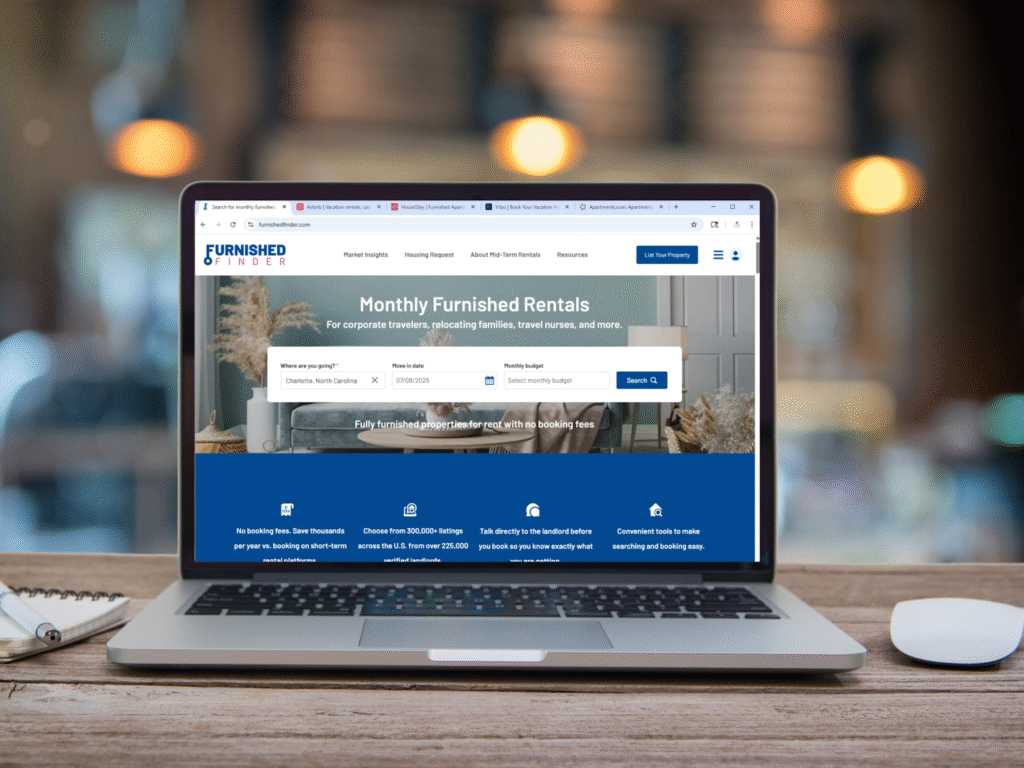
- Furnished Finder: This is the top travel nurse housing website and should be your first stop. It’s a platform designed specifically for traveling healthcare professionals, with no booking fees and direct communication with landlords.
- Airbnb & Vrbo: While these platforms are great for tourists, they also offer many furnished rentals for travel nurses for more extended stays. You can often get a discount for a 30+ day booking.
- Zillow & Apartments.com: Use these sites to find traditional apartment and house rentals. Be sure to filter for “furnished” and “short-term” or “month-to-month” leases.
- Homestay.com: Specializes in room rentals within someone’s home, often at a very affordable rate.
- Facebook Groups: Many local and national traveling nurse housing groups in Florida exist, where you can find listings from other nurses and landlords. Search for “travel nurse housing” and your specific city or state.
And of course: your Advantis housing team. Our housing support team will verify listings, find pet-friendly units, and match nurses to the best locations.
Can You Get Around Florida Without a Car?
Florida is a large, car-dependent state, and for many travel nurses, a car is a necessity. Public transit is available in major metro areas, but it’s not as extensive as in other parts of the country.
Parking can swing your budget by $100–$250/month in urban garages. Confirm availability and fees before you sign.
- Miami: Metrorail, Metromover, Metrobus cut parking hassles. Choose apartments near stations in Brickell, Downtown, Dadeland, or Civic Center.
- Orlando: LYNX bus and SunRail help downtown and hospital corridors.
- Tampa: HART bus and TECO Streetcar connect Ybor, Channelside, and Downtown. Many travelers still rely on a car.
- Jacksonville: JTA bus and Skyway serve the urban core; most travelers drive.
If you don’t own a car, try to live near your hospital or a reliable bus route. If you do have a car, keep in mind that Florida has heavy traffic, especially in cities like Orlando, Tampa, and Miami. Traveling nurse housing in Florida, close to your job, saves a lot of time on your commute each week.

Safety First: Florida-Specific Housing Tips
- Verify Details: Confirm owner/manager names, business records, and the exact unit address before you pay. Use in-platform payments on any travel nurse housing website; avoid wire transfers and gift cards.
- Request a Live Tour: Ask for a video walk-through. Check windows, locks, AC, parking, and noise at your shift hours (especially nights).
- Storm Readiness: Check flood zones, shutters or impact glass, backup generators, and property storm policies.
- Plan for Transport: Ask about parking fees, tolls, and transit costs. Miami garages and Orlando toll roads can add up quickly.
- Know Your Roommates: If sharing, align on sleep schedules, pets, guests, and shared expenses before moving in.
A Travel Nurse Agency That Truly Cares
Securing travel nurse housing in Florida is just one step of your journey—you deserve a partner who’s with you every step of the way. That’s where Advantis Medical, the #1 travel nurse agency, comes in. With 700+ five-star reviews, we’re trusted for providing concierge-level support, from top travel nursing jobs and transparent pay packages to hands-on housing assistance. Our team will walk you through it all, pull vetted listings from every major housing platform, and weigh commute options so you can focus on what matters most—delivering excellent patient care.
FAQs for Travel Nurse Housing in Florida
How do travel nurses find short-term rentals in Florida?
Most nurses look for housing through Furnished Finder, Airbnb, or agency lists. Some also find housing through other nurses in social groups.
How do housing stipends work for travel nurses in Florida?
Travel nurses who have a tax home will receive tax-free stipends for duplicate housing costs while on assignment. If your rent is lower than the stipend, you may keep the difference.
What hurricane factors should travel nurses consider in Florida?
Check if the building has shutters, clear storm rules, and renter’s cover. Ask about evacuation paths before signing.
Will my travel nursing agency provide housing support in Florida?
Yes, many agencies like Advantis Medical offer concierge-style housing support, helping nurses find and book affordable, safe housing that fits their stipend.
What types of travel nurse housing are available in Florida?
Travel nurses can choose from extended stay hotels, furnished apartments, condos, townhouses, or rental homes depending on assignment length and budget. There are many exciting traveling nurses housing in Florida.


