

2026 Guide: Moving Compact-to-Compact & The NLC 60-Day Rule


In this article
When you’re a travel nurse, navigating interstate licensing is just as important as mastering a new EMR—especially under the Nurse Licensure Compact (NLC). A new rule to understand is the 60-day requirement that starts when your Primary State of Residence (PSOR) changes to a new compact state. According to the NLC, once you establish legal residency in a new state, you have 60 days to apply for a new multistate license in that state. During that window, your previous multistate license remains active, but if you miss it, your multistate privileges can lapse.
For travelers, that can mean paused onboarding, delayed start dates, or even losing out on an assignment.
The good news is this is completely avoidable with the right planning and support.
Don’t let a paperwork technicality slow you down. Here’s what you need to know.
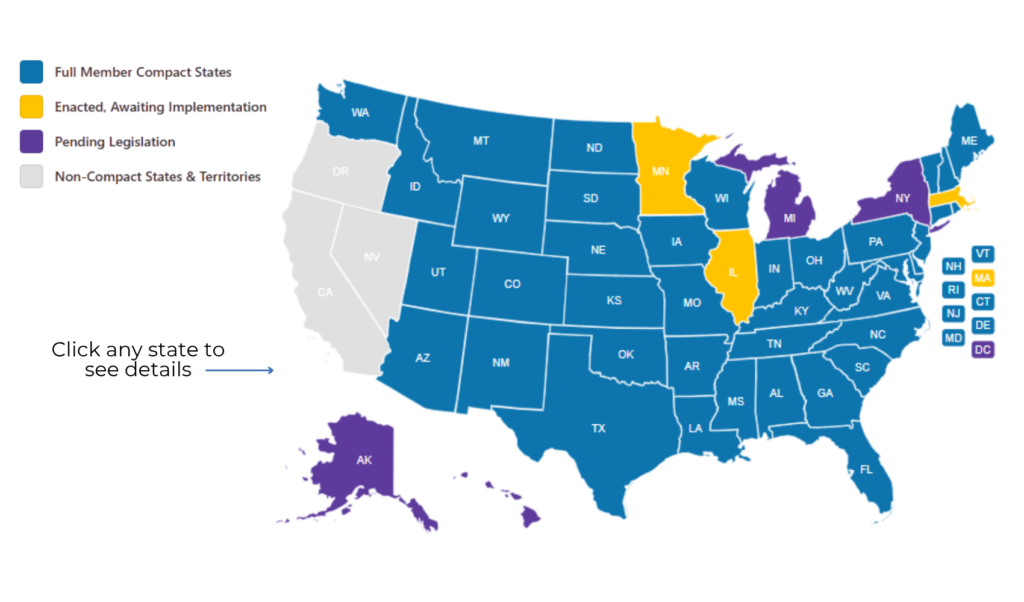
With the NLC covering 43 states and territories, knowing how to easily navigate interstate practice is non-negotiable. If you are new to multistate licensing, we highly recommend starting with our complete 2026 guide to the Nurse Licensure Compact. According to the Bureau of Labor Statistics, there are nearly 194,500 registered nurse job openings projected each year on average through 2032, and hospitals rely heavily on travelers to fill those gaps. You need to keep your license active to take advantage of that demand.
This guide breaks down exactly what you need to know about the 60-Day Rule to avoid losing a contract over a paperwork technicality, including:
- The intricate details of Rule 402.2
- When to change your Primary State of Residence (PSOR)
- What triggers the 60-day clock
- 4 common pitfalls
- Exceptions for military families
- A compliance checklist
The NLC 60-Day Rule at a Glance
Before diving into the full details, here is how the rule works in practice.
- What triggers the clock? Legally changing your Primary State of Residence (driver’s license, voter registration, tax filing).
- What is the deadline for? Submitting your complete application, not getting the physical license.
- Can I work while I wait? Yes. If you apply within 60 days, NLC Rule 403.1 allows you to practice under your former compact license.
- Does taking a travel contract in a different state trigger the rule? No. Temporary assignments do not trigger the rule as long as your PSOR stays in your original licensed state.
- What if I miss the deadline? You lose multistate privileges and must apply for a single-state license in your new home state.
What NLC Rule 402.2 Actually Says
“A multistate licensee who changes primary state of residence to another party state shall apply for a multistate license in the new party state within 60 days.” — NLC Rule 402.2
Here’s what that actually means:
You must submit your completed application within 60 days of establishing residency in your new state. You do not need to have your new license approved within that timeframe. State boards can take weeks to process applications, and that timing is outside of your control.
What matters is that your application is fully submitted within the 60-day window. As long as you meet that requirement, you remain compliant under NLC guidelines while your new license is being processed.
Just as important, this rule only applies if you are permanently changing your Primary State of Residence (PSOR). Taking a temporary assignment in another compact state and then returning to your home state does not trigger the 60-day requirement. As long as your legal residency stays the same, your existing multistate license remains valid for practice in other compact states.
The 60-day clock starts the moment you legally establish residency in a new compact state; things like updating your driver’s license, voter registration, or tax home.
And one key detail: you won’t apply through the NLC itself. You must submit your application directly to your new state’s Board of Nursing, since each state manages its own licensing process and proof-of-residency requirements.
The safest move is to review your target state’s licensing requirements ahead of time so you’re ready to submit within that 60-day window.
Understanding Your Primary State of Residence
Your PSOR, is your legal home state. For NLC purposes, you can only have one PSOR at a time. This is the state where you hold your driver’s license, register to vote, and file your federal taxes.
Moving your permanent residence affects your NLC licensing. To officially set up your PSOR in a new state and satisfy the board’s requirements, you generally need to obtain a new driver’s license with your new address, update your voter registration, and list the new state when you file your taxes. Since these documents all need to align, coordinating them quickly after a permanent move is crucial.
It’s also important to note that property ownership alone does not establish residency. Owning a second home, renting, or staying in another state for a temporary assignment does not automatically change your PSOR. Your PSOR only changes when you take clear legal steps to make that state your permanent home.
- Highest-paying states and cities, ranked from live contracts
- Take-home pay and tax considerations
Common Scenarios: Does the 60-Day Rule Apply?
To clear up the confusion, here is how the NLC 60-day rule applies to the most common travel nursing situations.
Temporary Travel Assignment
You live in Oregon and take a 13-week contract in Colorado. You rent a short-term apartment near the hospital, but your tax home, driver’s license, and voter registration all remain in Oregon.
Does the 60-day rule apply? No.
You have not changed your PSOR because your legal residence is still Oregon. You can complete your assignment and return home without applying for a Colorado license.
Permanent Relocation
You hold a Texas compact license but decide to permanently move to Arizona. You sign a long-term lease, get an Arizona driver’s license, and register your car there.
Does the 60-day rule apply? Yes.
The clock starts the day you legally establish residency in Arizona. You must submit your Arizona license application by endorsement to the Arizona Board of Nursing within 60 days.
Vacation Rentals
You live in Utah and maintain all your legal residency documents there. Each winter, you rent a condo in Florida for several months and pick up PRN shifts.
Does the 60-day rule apply? No.
Short-term stays and rental properties do not change your PSOR. Because your legal residence remains in Utah, you can practice in Florida under your Utah multistate license.
Military Family Exception
Military families often relocate due to duty station changes. Under NLC guidelines, these moves are typically considered temporary.
Does the 60-day rule apply? Usually no.
Military nurses and spouses can maintain their original PSOR and practice in another compact state under their existing multistate license without triggering the 60-day requirement.
Moving to a Non-Compact State
You live in Georgia, a compact state, and move permanently to Illinois, a non-compact state.
Does the 60-day rule apply? No.
The 60-day rule does not apply because you are leaving the compact network. Your Georgia multistate license immediately reverts to a single-state Georgia license. To practice in Illinois, you must apply for an Illinois single-state license.


Four Common License Pitfalls to Avoid
A great contract can fall apart quickly if your license isn’t in order. Even experienced travelers run into issues because small details get missed. Here’s where most common licensure pitfalls and how to avoid them:
1. Waiting for License Approval
You do not need your new license issued within 60 days, you just need to submit a complete application within that window.
As long as your application is submitted on time, you remain compliant while your new license is being processed (based on state board guidelines). Waiting for approval before taking action is one of the fastest ways to fall behind.
2. Submitting an Incomplete Application
Missing documents; like proof of residency, signatures, or verification forms, can stall your application for weeks.
Before submitting, double-check every requirement. After submitting, monitor your application status so you can quickly fix any issues and keep things moving.
3. Running Into a License Gap
If your previous multistate license deactivates before your new one is issued, you could face a gap in your ability to work.
If timing is tight, contact your new state’s Board of Nursing early. Some states offer temporary permits that can help you stay active while your application is being finalized.
4. Misunderstanding Residency Requirements
You can only hold one PSOR at a time. Trying to maintain residency in multiple states, or not fully updating your legal documents, can lead to compliance issues.
Make sure your driver’s license, voter registration, and tax home all align with your current PSOR.
What Happens If You Miss the 60-Day Deadline?
If you miss the 60-day deadline to submit your compact license application, your multistate privileges lapse. This means your license reverts to a single-state license valid only in your former home state. You immediately lose your interstate privileges.
Continuing to practice in a new state without active multistate privileges constitutes practicing without a valid license. State boards enforce Rule 402.2 strictly, and consequences for non-compliance can include warning letters, fines, probation, and board disciplinary action. Administrative delays usually result in warnings or fines.
If you realize you missed the deadline, submit your endorsement application immediately. You will remain in an NLC violation status until the board issues your new license, but applying immediately is the only way to mitigate the administrative penalties.
Your Interstate Compliance Checklist
Use this scannable checklist to stay strictly on track when you establish permanent residency in a new compact state.
| Timeline | Compliance Checklist Items |
| Before the Clock Starts (Moving + Setup) | Secure your permanent address (lease, home purchase, etc.). Begin updating key residency documents like your driver’s license and voter registration. Review your new state’s Board of Nursing requirements so you’re ready to apply. |
| Day 1 (PSOR Established) | Mark your official PSOR change date. Gather finalized proof of residency (driver’s license, voter registration, lease, etc.). |
| Days 1–30 | Complete your endorsement application. Upload all required residency documents. |
| Days 30-60 | Submit your completed application before the 60-day deadline. Sign up for Nursys eNotify alerts to track license status. |
| Ongoing | Check your application status weekly. Respond quickly to any Board of Nursing requests. Keep copies of all submitted documents for your records. |
Ready to Find Your Next Travel Nursing Adventure?
At Advantis Medical, we don’t just help you understand the NLC; we help you leverage it to land your dream travel assignment. We are consistently rated as a top travel nursing agency by our providers, boasting over 700 verified five-star reviews.
Your dedicated recruiter serves as your career champion, giving you access to exclusive, high-paying travel nurse jobs across our network of top-tier hospital partners. The Advantis difference means a stress-free journey, unparalleled clinical support, and a strict commitment to your career growth.
Once your license is settled, check out our guide to travel nurse job hotspots to plan your next move. Head over to our job center to explore open contracts and connect with a pro recruiter today to lock in your next assignment.
FAQs About the NLC 60-Day Rule
What is the NLC 60-day rule?
The NLC 60-day rule requires nurses who legally change their primary state of residence (PSOR) from one compact state to another to submit an application for a new multistate license within 60 days of establishing residency. The current rule took effect on January 2, 2024.
What legally triggers the 60-day clock?
The 60-day clock begins once you legally establish permanent residency in a new compact state. This is formally triggered when you update your legal documents, such as getting a new driver’s license, registering to vote, or changing your tax address to the new state.
Can I still work while waiting for my new license to be approved?
Yes. Under NLC Rule 403.1, as long as you submit your complete application within the 60-day window, you can continue practicing under your former compact license while the new state’s Board of Nursing processes your paperwork.
Do temporary travel nurse contracts trigger the 60-day rule?
No. Taking a 13-week travel contract in a new state does not trigger the 60-day rule as long as you maintain your legal residency (driver’s license, voting, and taxes) in your home state and intend to return there.
Does owning a house in another state change my compact license?
No. The NCSBN states that your Primary State of Residence pertains to your legal residency status, not property ownership. Owning a second home or vacation property does not trigger the 60-day rule.
What happens if I miss the NLC 60-day deadline?
If you fail to submit your application within 60 days, your multistate privileges lapse. Your license reverts to a single-state license valid only in your former home state. Practicing across state lines after this lapse violates the Nurse Practice Act and can result in board discipline, fines, or probation.
Can I hold a multistate license in two different states?
No. Under the rules of the Nurse Licensure Compact, you cannot hold a multistate license in more than one state at the same time. You must declare a single Primary State of Residence.
What if I move from a compact state to a non-compact state?
You no longer qualify for a compact license. You must apply for a single-state license in the non-compact state. Your existing compact license will not give you multistate privileges there.


