

2026 Guide: Post-Acute Care vs. Skilled Nursing Jobs


In this article
If you are exploring your next travel contract, you have probably seen the terms post-acute care and skilled nursing used interchangeably on job boards. While they both focus on helping patients recover outside of a traditional hospital environment, they aren’t the exact same.
If you do not know the difference between these settings, it can lead to burnout if expectations don’t match the role.
For travel nurses, understanding the nuances between these two environments affects everything from your daily patient ratios and the specific clinical skills you use to the overall pace of your 12-hour shift.
Whether you are an RN looking to step away from the adrenaline spikes of high-acuity intensive care units or an LPN seeking long-term contract stability, this guide breaks down exactly what you need to know about post-acute care versus skilled nursing and how to choose the right environment for your next assignment.
The Short Answer
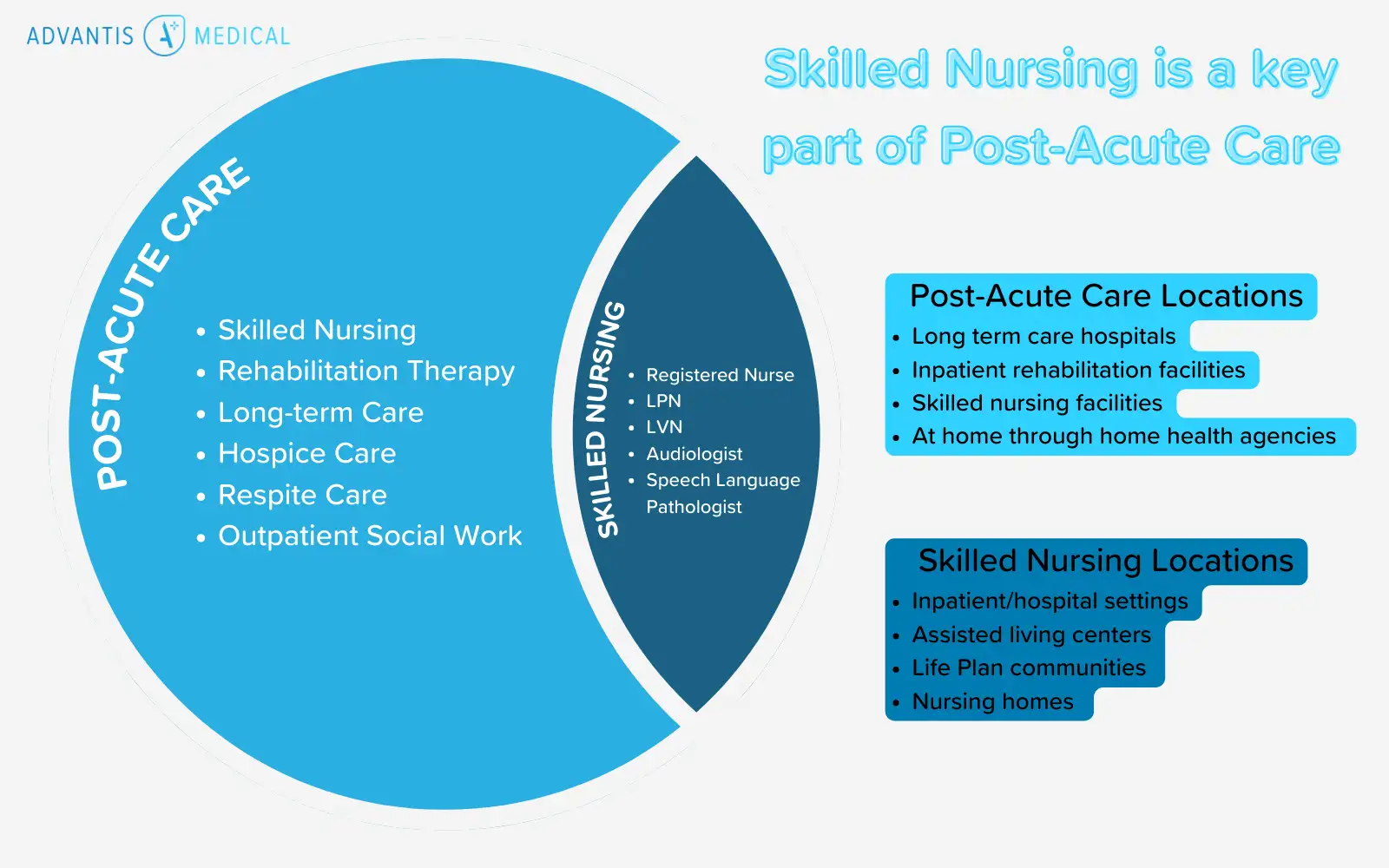
Post-acute care is a broad umbrella term. Skilled nursing is simply one specific branch that falls under that umbrella.
All skilled nursing facilities provide post-acute care, but not all post-acute care happens in a skilled nursing facility. Understanding the other branches of this umbrella is important for finding your ideal nursing opportunity.
Post-Acute vs. Skilled Nursing at a Glance
| Feature | Post-Acute Care | Skilled Nursing |
| Scope | A broad umbrella category covering all recovery care after a hospital stay. | A specific, highly regulated level of clinical care within the post-acute spectrum. |
| Typical Goal | Transition safely from the hospital to home, or manage long-term decline. | Restore specific functions and prevent hospital readmission through daily therapies. |
| Duration | Highly variable. Can range from a few days to months or years. | Typically short-term rehabilitation, usually lasting weeks rather than months. |
| Workflow Intensity | Varies by setting; focused on specialized therapies or complex medical management. | High-intensity medication passes and structured daily rehabilitation schedules. |
| Facility Types | Inpatient rehab, long-term care hospitals, home health, and skilled nursing facilities. | Primarily freestanding skilled nursing facilities or hospital transitional care units. |
What is Post-Acute Care?
Post-acute care refers to the medical services provided to patients in the short- or long-term immediately following discharge from an acute care hospital.
A patient entering a post-acute care environment is typically too stable to remain in a high-cost hospital bed, but not quite stable enough to be discharged to their own home without medical supervision. According to data from the Medicare Payment Advisory Commission (MedPAC), over 40% of Medicare beneficiaries discharged from acute care hospitals are admitted to a post-acute care setting for further recovery.
These patients usually require specialized follow-up services such as intensive physical therapy, occupational therapy, speech therapy, prolonged intravenous antibiotic therapy, or complex wound care. Depending on the type of injury or trauma, patients can stay for a few days or several weeks. An exception to this timeline is hospice care, where a patient’s comfort is managed until they pass.
To better understand the full scope of this medical sector, you can read our foundational guide detailing what is post-acute care and why it is vital to patient recovery.
Post-Acute Care Services
Because treatment plans vary wildly by case, post-acute care covers a massive spectrum of services, including:
- Skilled nursing
- Rehabilitation therapy
- Long-term care
- Hospice care
- Respite care
- Outpatient social work
Post-Acute Care Settings
Because the services are so varied, post-acute care is delivered across several different types of facilities.
- Long-term care hospitals (LTCH)
- Inpatient rehabilitation facilities (IRF)
- Skilled nursing facilities (SNF)
- At home through home health agencies
What is Skilled Nursing?
Skilled nursing care is a highly specific, short-term subset of post-acute care focused on helping patients regain the ability to resume the activities of daily living after a severe illness, injury, or surgical procedure.
According to the Centers for Medicare & Medicaid Services (CMS), Medicare explicitly defines and covers skilled nursing facility care only if it is certified by a physician and requires the daily, active involvement of skilled nursing or rehabilitation staff. This means the care cannot be safely provided by a non-medical caregiver or family member at home.
The American Health Care Association (AHCA) notes that skilled nursing encompasses specialized services like advanced wound care, tube feedings, post-surgical monitoring, and intensive rehabilitation regimens. Because of the medical knowledge required, it must be provided by licensed health professionals.
The Medicare 3-Day Rule
One of the defining characteristics of skilled nursing care is how it is regulated and paid for. The Centers for Medicare & Medicaid Services has strict guidelines for covering a stay in a skilled nursing facility.
To qualify for Medicare Part A coverage for skilled nursing facility services, a patient must meet the 3-day rule. This requires the patient to have a medically necessary, consecutive three-day inpatient hospital stay prior to their admission to the skilled nursing facility.
Providers Who Administer Skilled Nursing Care
- Registered nurses
- Licensed practical nurses
- Licensed vocational nurses
- Audiologists
- Speech-language pathologists
- Physical and occupational therapists
Skilled Nursing Settings Based on Patient Needs
- Freestanding skilled nursing facilities
- Inpatient and hospital transitional care units
- Some assisted living communities may offer limited skilled services, but they are not classified as skilled nursing facilities
- Life Plan Communities
- Nursing homes
- Highest-paying states and cities, ranked from live contracts
- Take-home pay and tax considerations
The Day-to-Day Reality for Travel Nurses
Understanding the definitions is helpful, but knowing how these environments alter your daily workflow is what actually matters when selecting a travel job. Here is how post-acute care and skilled nursing compare on the floor.
Patient Acuity and Pacing
If you accept a post-acute contract at a long-term care hospital or an inpatient rehab facility, you are generally dealing with higher patient acuity. You might manage patients on ventilators, handle complex cardiac drips, or assist with intense stroke rehabilitation. The pacing can mirror a step-down unit, and your patient ratios are usually kept much lower.
If you accept a contract at a skilled nursing facility, the overall medical acuity is generally lower, but the volume of patients is much higher. Travel nurses in SNFs often manage chronic conditions like diabetes, COPD, and heart failure, while focusing heavily on rehabilitation and preventing hospital readmissions.
SNF pacing is different than an ER nurse. It’s heavily driven by strict medication administration schedules and wound care rounds. Patient ratios in an SNF are notoriously higher, frequently stretching to 1:15 or more, requiring time management and delegation skills.
Required Skill Sets and Certifications
Post-acute roles in LTCHs or IRFs demand strong acute-care skills, rapid assessment capabilities, and a deep understanding of complex disease processes. It is a fantastic environment for nurses who want to utilize their critical thinking skills without the constant chaos of an emergency room.
Skilled nursing roles require elite organizational skills, patience, and strong communication. Because patients often stay in SNFs for weeks, you build stronger, more personal relationships with them and their families. SNF nurses must be highly proficient in geriatric pharmacology, fall prevention, and collaborating with physical therapy teams.
While basic RN or LPN licensure is usually sufficient to start, earning specialized credentials like becoming Wound Care Certified (WCC) or a Certified Rehabilitation Registered Nurse (CRRN) can significantly boost your pay and make you highly competitive for top travel contracts.


Why Travel Nurses Are Choosing These Specialties
Both types of care are vital to our healthcare system, providing respite from hospital overcrowding and ensuring complete care for patients by decreasing their risk of readmission. The demand for nurses in both post-acute and skilled nursing environments is skyrocketing, heavily driven by shifting demographics.
According to the United States Census Bureau, by the year 2030, all baby boomers will be age 65 or older. This demographic shift means the healthcare system is facing a massive influx of older adults requiring extended medical care and rehabilitation.
The Bureau of Labor Statistics projects massive ongoing demand across all nursing levels to meet this need. Employment for RNs is projected to grow 6% from 2022 to 2032, with about 189,100 openings each year on average. Simultaneously, employment for vocational and licensed practical nurses (LPNs) will grow 5%, with about 54,400 openings each year. If you want to capitalize on this growing market, you can explore open travel LPN jobs right now.
For travel nurses, this massive demand translates to more job security, highly competitive pay packages, and the flexibility to pick contracts in almost any city in the country. You can browse travel nurse jobs to see the lucrative contracts currently available in this sector.
Comparing Med Surg to Post-Acute Nursing
Because of the Medicare 3-day inpatient requirement, Med Surg and Telemetry floors are the primary feeder units for skilled nursing facilities. The patients you treat in a post-acute setting are often just discharged from a hospital floor, making these two specialties two sides of the same clinical coin.
Because the patient populations overlap so heavily, nurses in both environments share a transferable skill set. Both require skills in polypharmacy, complex wound care, diabetic management, and family education.
However, moving between these specialties offers different career benefits depending on your long-term goals:
- Moving from skilled nursing to Med Surg: Nurses looking to eventually transition into high-acuity specialties like the ICU or ER often work in Med Surg first to build their acute-care hospital resume.
- Moving from Med Surg to skilled nursing: Nurses exhausted by acute care often move to post-acute facilities to enjoy more clinical autonomy and build longer-term relationships with their patients.
If you are looking for a slightly different pace than a skilled nursing facility, we have several positions available if you want to expand your acute-care resume. You can watch our recent Med Surg/Tele travel nurse video to see what it is like working with our team or explore open Med Surg travel nurse jobs nationwide.
Find Your Next Assignment with Advantis Medical
Advantis Medical Staffing is here to help support your career journey into skilled nursing or post-acute care. From helping you secure jobs in your dream destinations to utilizing the websites to find travel nurse housing to secure the perfect short-term lease, our team is here to be your ultimate career companion.
We take great pride in supporting our providers with more than just top jobs. We are building trusted, long-term partnerships that make your journey smoother and more rewarding, which is exactly why we were rated #2 for nurse experience in healthcare by MIT.
With over 700 five-star reviews, we have earned our reputation as one of the best travel nursing agencies to work for. Start your next adventure today and explore open contracts to discover what is possible for your career.
FAQs About Post-Acute and Skilled Nursing
What is the main difference between post-acute care and skilled nursing?
Post-acute care is an umbrella term covering all medical services after a hospital stay. Skilled nursing is a specific type of post-acute care that includes licensed nursing services such as wound care, IV therapy, and intensive rehabilitation.
Is a skilled nursing facility the same as a post-acute care facility?
Not exactly. A skilled nursing facility is one specific type of post-acute care setting. Other post-acute settings include inpatient rehab facilities, long-term care hospitals, and home health agencies.
What is the Medicare 3-day rule?
To qualify for Medicare Part A coverage for skilled nursing facility care, a patient must have a medically necessary, consecutive three-day inpatient hospital stay prior to their admission to the facility.
Which pays more for travel nurses: post-acute or skilled nursing?
Pay varies widely by location, facility, and patient acuity. In general, skilled nursing facilities and long-term care hospitals often offer more competitive rates due to severe staffing shortages.
Do I need special certifications to work in skilled nursing?
Basic RN or LPN licensure and BLS certifications is usually sufficient to start.
What are the typical nurse-to-patient ratios in skilled nursing facilities?
Ratios vary heavily by state and facility. In many skilled nursing facilities, RNs may manage 15 to 25 patients, while LPNs may manage 10 to 15. You should always ask about patient ratios during your travel contract interview, as they directly impact your workload and job satisfaction.
Can travel nurses work in post-acute care?
Absolutely. Travel nurses are in high demand for short-term contracts in skilled nursing facilities, long-term care hospitals, and home health agencies.
Is post-acute care considered high acuity?
Post-acute care acuity varies widely. Settings like long-term care hospitals (LTCHs) and inpatient rehabilitation facilities (IRFs) can involve high-acuity patients requiring ventilators or stroke recovery. Skilled nursing facilities typically manage lower medical acuity but much higher patient volume.


