

Best Travel Nurse Housing in Florida: Nursing Rental Sites & Insider Tips

In this article
- What to Check Before You Sign in Florida
- What Florida Housing Actually Costs
- Five Short-Term Housing Types, Compared
- Travel Nurse Housing in Miami: Costs & Commute
- Travel Nurse Housing in Orlando: Costs & Transit
- Travel Nurse Housing in Tampa: Rent & Commute
- Travel Nurse Housing in Jacksonville & Other Markets
- Where to Search and How to Verify Before You Pay
- FAQs for Travel Nurse Housing in Florida
Finding the right travel nurse housing in Florida takes more than comparing monthly rent. In the four markets covered here, average conventional apartment rents range from about $1,517 in Jacksonville to $2,770 in Miami, and furnished short-term options can price very differently.
Your real housing budget should include the full move-in cost, utilities, parking, pet or application fees, and the commute you’ll make on every shift. A unit that looks cheaper on paper can cost more once those extras are added.
Florida also adds a few state-specific considerations. Hurricane season runs from June through November, and the state’s flood-disclosure rule applies only to leases of one year or longer, so a landlord may not be required to provide that disclosure for a typical 13-week lease. This guide breaks down what to ask before signing, current cost benchmarks, city-by-city differences, and how to verify a rental before you pay.
Whether you’re setting off for your first travel nursing job in Florida or returning for another assignment, these insights will help you feel prepared to find travel nurse housing in Florida.
What to Check Before You Sign in Florida
Before you commit to a rental, make sure it works for your contract dates, your budget, your shift, and Florida’s weather. The most useful questions are practical ones: What will you pay upfront? How long is the lease? What happens if the assignment changes? And what is the property’s plan during a storm?
Hurricane season and lease terms
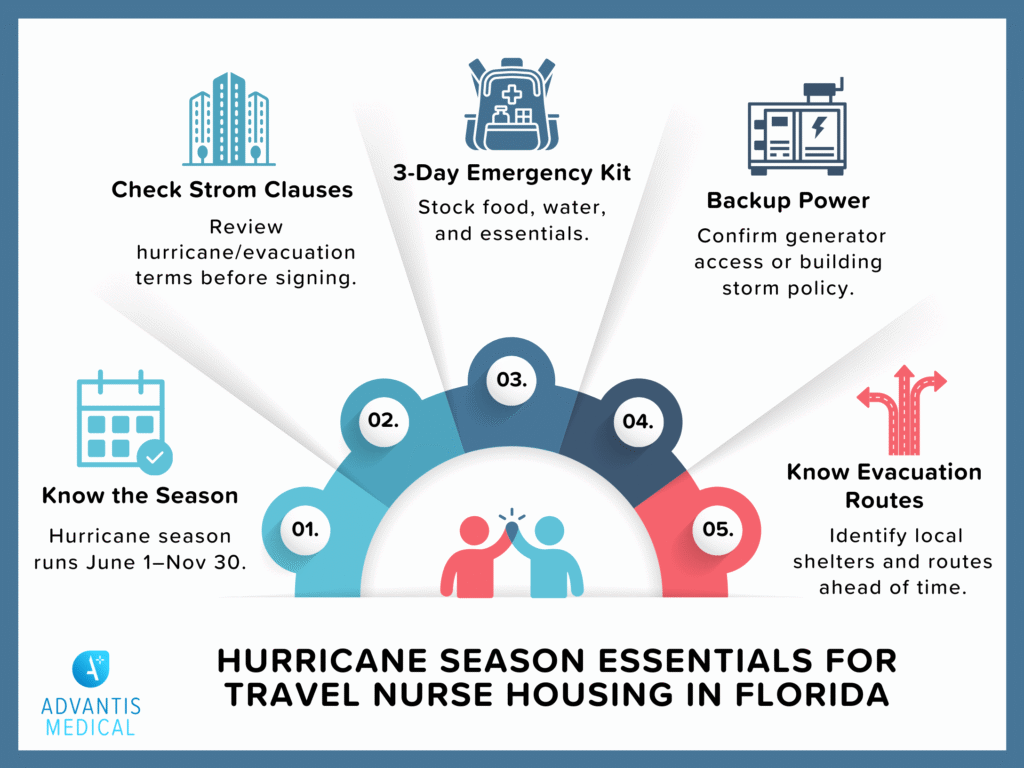
Florida’s hurricane season runs June 1 through November 30, so many 13-week assignments will overlap with at least part of it. The Florida Division of Emergency Management recommends keeping at least seven days of food, water, medicine, batteries, and other essentials on hand.
When you’re comparing rentals, ask what storm preparation is already built into the property. Does it have shutters or impact-resistant windows? Is the unit in an evacuation or flood zone? Where does management post updates?
Also find out how the property handles evacuations, re-entry, and damage that makes the unit temporarily unusable. Then check the lease for language about casualty damage, loss of access, evacuation, early termination, and responsibility for personal property.
If you’re buying renters insurance, ask specifically what the policy covers for personal property and temporary living expenses. Get the limits and exclusions in writing so you know what protection you actually have.
Security deposits and fees
Florida Statutes section 83.49 explains how covered landlords may hold security deposits, including in a qualifying Florida account or through a surety bond. The arrangement generally must be disclosed in the lease or within 30 days of receiving the deposit. The notice requirement does not apply to landlords renting fewer than five units, which can include some owner-direct rentals.
The return timeline matters, too. If the landlord has no claim against the deposit, it must generally be returned within 15 days. If there is a claim, the landlord must send written notice within 30 days, either by certified mail or by email when both sides have elected electronic notice under section 83.505.
After a claim notice, you generally have 15 days to object in writing. If the landlord misses the 30-day notice deadline, the deposit must be returned, although the landlord may still pursue damages separately.
If you leave before the lease term ends, Florida law also calls for at least seven days’ written notice by certified mail or personal delivery, along with a forwarding address, unless your lease says otherwise.
Skipping that notice can affect the landlord’s normal claim-notice obligations. Your deposit rights do not automatically disappear, but this is one of those lease details worth understanding before move-in. This is general information, not legal advice.
What Florida Housing Actually Costs
Florida’s statewide cost-of-living numbers sit close to the U.S. average, but that doesn’t mean every Florida assignment will feel the same financially. Miami, Orlando, Tampa, Jacksonville, and smaller markets can look very different once rent, commuting, parking, and furnished availability are included.
Cost-of-living context
MERIC’s Cost of Living Data Series uses 100 as the U.S. benchmark and reports the following Florida indices for the first quarter of 2026. If you’re still planning the assignment itself, our Florida nursing license guide covers the licensing side of the move.
| Category | Florida index | What it means for your budget |
| Overall | 100.7 | Close to the U.S. benchmark |
| Housing | 101.1 | Close to the U.S. benchmark |
| Health | 101.4 | Slightly above the benchmark |
| Groceries | 105.7 | Above the benchmark |
| Utilities | 94.6 | Below the benchmark |
Current benchmarks
Use these current benchmarks as a starting point for your housing budget, then compare them with the specific unit, lease term, and commute you’re considering.
| Cost item | Current benchmark | What to keep in mind |
| Florida average rent | $2,350 | Zillow, all bedrooms and property types; source updated August 15, 2026 |
| Florida one-bedroom rent | $1,719 | Zillow, one-bedroom apartments; source updated August 15, 2026 |
| Typical FPL 1,000-kWh bill | $136.64 | FPL’s published 2026 typical residential bill. FPL lists $128.45 for September after a one-month storm-cost refund, and FPL is not the only Florida utility. |
| Florida regular gasoline | About $3.85 per gallon | AAA Florida regular average on August 17, 2026; recheck on the actual publication date. |
The Zillow Florida rental market page, FPL rate page, and AAA Florida gas page are useful places to check current numbers. Because rent, utility rates, and gas prices can change quickly, use the date on the source instead of relying on a number you saved weeks ago.
Stipend math and taxes
A housing allowance can make the budget look straightforward, but the simple subtraction doesn’t tell you what you actually keep. If your allowance is $3,800 a month and rent is $2,100, the difference is $1,700 before utilities, deposits, fees, parking, and transportation.
That difference also isn’t automatically tax-free. Your tax treatment depends on more than the amount left after rent, so don’t treat the gap as guaranteed savings.
IRS Publication 463 explains that treatment can depend on your tax home, whether the assignment is temporary, substantiated expenses, applicable limits, and your employer’s reimbursement plan. Excess reimbursement that isn’t properly substantiated or returned may be treated as wages.
Our guide to travel nurse tax homes explains the basic qualifying conditions. If you’re comparing your own rental with agency-arranged housing, the housing stipend vs. agency-provided housing guide covers the tradeoffs. You can also compare the written pay package with current Florida travel nurse salary data, then talk with a qualified tax professional about your individual situation.
Five Short-Term Housing Types, Compared
Short-term housing for travel nurses in Florida can look very different depending on the property type. The right fit depends on how much privacy you want, how quickly you need to move in, whether you’re bringing a partner or pet, and how much flexibility you need around contract dates. In Florida, also compare utility caps, storm-readiness features, parking, and any condo or association rules that could affect your stay.
| Housing type | Good fit for | Watch for |
| House or townhouse | More space, pets, or family | Utilities, yard care, and longer terms |
| Apartment or condo | Amenities and maintenance support | Application rules, fees, and association limits |
| Shared housing | Lower cost and flexible room rentals | Privacy, sleep schedules, and shared expenses |
| Extended-stay hotel | Last-minute arrivals or interim stays | Taxes, parking, pet fees, and rate changes |
| Furnished rental | Minimal setup with assignment-length dates | Utility caps, inventory, and cancellation terms |
House or townhouse
A house or townhouse can give you more room, a private entrance, and more flexibility for a partner, family, or pets. The tradeoff can be higher utilities, yard responsibilities, a larger deposit, or a lease term that doesn’t line up as neatly with a 13-week contract. Compare the full cost, not just the extra space.
Apartment or condo
Apartments and condos can make day-to-day life easier with on-site maintenance, controlled access, pools, gyms, or covered parking. Before you apply, check the lease-length rules, move-in fees, guest policies, and any condo or association restrictions. Make sure the unit you toured is the unit named in your lease.
Shared housing
Shared housing can lower your monthly cost and often includes utilities, but the roommate setup matters just as much as the price. Talk through sleep schedules, guests, pets, cleaning, kitchen use, and thermostat preferences before move-in, especially if you work nights.
Extended-stay hotel
Extended-stay hotels are useful when you need something quickly or want a temporary landing spot while you look for a longer-term rental. Furnishings and basic utilities are usually built into the rate. Ask whether that rate is guaranteed for your full stay and whether the property can move you to a different room during the assignment.
Furnished rental
A furnished rental can keep setup simple because you don’t have to buy or move furniture. Still, photos don’t tell you everything. Ask for a current video walkthrough and a written list of what’s included, including cookware, laundry, parking, internet, utilities, and any usage caps.
- Highest-paying states and cities, ranked from live contracts
- Take-home pay and tax considerations
Travel Nurse Housing in Miami: Costs & Commute
Travel nurse housing in Miami can vary dramatically by neighborhood, so citywide averages are only a starting point. The RentCafe Miami market report lists an August 2026 average apartment rent of $2,770 and a one-bedroom average of $2,444. Those figures cover conventional buildings with 50 or more units, not furnished monthly travel rentals, so your actual options may price differently.
Neighborhood and nearby-market price signals
For context, these August 2026 conventional-apartment averages show how much the market changes from one area to another:
- Brickell: about $3,766
- Wynwood: about $3,472
- Downtown Miami: about $3,306
- Little Havana: about $2,606
- Downtown Dadeland: about $2,499
- Kendall Commons: about $2,491
The same source also reports these averages for two nearby cities travelers may consider:
- Coral Gables: about $4,447
- Doral: about $2,880
The comparison is a good reminder not to assume a nearby city will automatically save money. In this dataset, Coral Gables averages more than every Miami neighborhood listed above. Little Havana, Downtown Dadeland, and Kendall Commons all come in below Downtown Miami, but your best option still depends on the facility, commute, and short-term availability.
Transit, parking, and shift fit
Miami-Dade Transit includes Metrobus, Metrorail, and Metromover. If a rental sits near a route that matches your facility and shift, transit can reduce parking and driving costs. The key is whether the service actually runs when you need it.
Check the first and last trips, transfer times, weekend schedules, and the walk on both ends before you count transit as part of your plan. A station close to your apartment doesn’t help much if service ends before your shift does.
If you’ll drive, ask for the monthly parking price and confirm whether the space is assigned, covered, and available overnight. In Miami, mileage alone is a poor way to judge a commute.
A shorter route can still take longer if it crosses a recurring bottleneck. Test the drive at the same times you’ll be going to and from the facility, including weekends if your schedule includes them.
Travel Nurse Housing in Orlando: Costs & Transit
Travel nurse housing in Orlando is less expensive on average than Miami in this dataset, but neighborhood prices still vary enough to change your housing plan. The RentCafe Orlando market report lists an August 2026 average apartment rent of $1,812 and a one-bedroom average of $1,598. These are conventional apartment figures, not furnished monthly rates.
Neighborhood price signals
Selected August 2026 conventional-apartment averages show the range:
- Baldwin Park: about $2,476
- Lake Formosa: about $2,343
- Downtown Orlando: about $2,100
- Lake Nona: about $1,952
- Rosemont: about $1,369
The spread is significant: Rosemont averages about $1,100 less than Baldwin Park in this dataset. That doesn’t automatically make it the better fit. Your facility address, shift, parking, and route should carry as much weight as the neighborhood’s average rent.
Transit and driving questions
LYNX provides local bus service across the Orlando area, and SunRail can be useful along the corridors it serves. Compare current schedules with your actual shift times, especially for weekends, early starts, and late departures.
If you’re driving, check the route at the hour you’ll actually commute. I-4, SR-408, toll roads, and major event traffic can all change the trip. The same goes for a transit connection that works at noon but not after a night shift.
Parking can also change the total cost. Ask whether it’s included, whether the garage has a wait list, and whether a second vehicle is allowed. A lower monthly rent may not save you much if the commute adds tolls and parking every week.


Travel Nurse Housing in Tampa: Rent & Commute
Travel nurse housing in Tampa also changes a lot by neighborhood. The RentCafe Tampa market report lists an August 2026 average apartment rent of $2,014 and a one-bedroom average of $1,730. Those are two different measures, so compare like with like when you’re building your budget. Furnished short-term listings can fall above or below either number depending on the dates, utilities, and lease terms.
Neighborhood price signals
These August 2026 neighborhood averages show the size of the spread:
- Downtown Tampa: about $2,924
- Channel District: about $2,670
- Tampa Heights: about $2,315
- Ybor: about $1,977
- North Tampa: about $1,126
North Tampa’s average is less than half of Downtown Tampa’s in this dataset. That’s useful for narrowing your search, but it shouldn’t be the only factor. Check whether short-term inventory is actually available for your dates and what the commute looks like from each area.
Transit and commute fit
HART operates bus routes across Hillsborough County. The TECO Line Streetcar runs a 2.7-mile route between Downtown Tampa, the Channel District, and Ybor City, free, seven days a week. It can be very useful when both your rental and facility are close to the line.
If you’re driving, test I-275, the Selmon Expressway, the bridges, and any cross-bay route at your normal commute time. Add tolls, parking, and after-hours garage access to the comparison. In Tampa, the cheapest neighborhood on paper isn’t always the cheapest or easiest once the route is included.
Travel Nurse Housing in Jacksonville & Other Markets
Jacksonville’s lower rent benchmarks can be appealing, but the city’s size makes commute planning especially important. The City of Jacksonville notes that it is the largest city by area in the continental United States. The RentCafe Jacksonville market report lists an August 2026 average apartment rent of $1,517 and a one-bedroom average of $1,336.
Jacksonville neighborhood signals
Selected conventional-apartment averages include:
- Riverside: about $1,936
- Southbank: about $1,762
- San Marco: about $1,754
- Mandarin Station-Losco: about $1,326
Riverside, San Marco, and Southbank can make some central-city commutes shorter, while southern and suburban areas may come with lower rent benchmarks. The tradeoff depends on where your facility sits.
Don’t rely on a five- or ten-mile radius alone in Jacksonville. River and bridge crossings can add more time than the distance suggests. Test the route around shift change and include parking and fuel in the housing comparison.
Regional apartment comparison
Using one source family and one reporting month makes these market averages easier to compare side by side:
| Florida market | Average apartment rent | Planning takeaway |
| Miami | $2,770 | Highest average in this comparison |
| Tampa | $2,014 | Lower than Miami, with a wide neighborhood spread |
| Orlando | $1,812 | Lower than Tampa and Miami in this dataset |
| Cape Coral | $1,715 | Compare current inventory with the commute |
| Jacksonville | $1,517 | Lowest average here, but the city covers a large area |
Use this table to narrow your search, not to predict the price of a furnished unit. A higher-rent apartment close to the facility may still cost less overall if it includes utilities and parking and cuts your commute. Once you have a shortlist, compare furnished inventory, full move-in costs, and the actual route for your contract dates.
Where to Search and How to Verify Before You Pay
Once you’ve narrowed your housing options, verify the property before you send money. Compare more than one source, confirm who owns or manages the unit, and make sure the full price is written into the lease. In Florida, add flood history, evacuation-zone information, and storm planning to your usual rental checks.
Your recruiter can explain what housing support is available with your assignment and may be able to share local context. You should still confirm the owner or manager, address, lease terms, and payment instructions directly before you pay.
Get the deposit, refund terms, move-out process, and every nonrefundable charge in writing. Pet, screening, cleaning, parking, and application fees can make a rental much more expensive than the headline price. Keep a copy of the lease, payment receipts, and move-in photos.
Where travelers look
Traveler-focused platforms and mainstream rental sites can both be useful for furnished monthly housing. Compare the total price for your full stay, deposits, fees, cancellation terms, utilities, and whether the owner will rent for your exact contract dates.
Traditional rental sites can expand your options, but a short-term filter doesn’t guarantee a landlord will accept a 13-week lease. Our guide to websites for travel nurse housing compares common platforms and what to look for on each one.
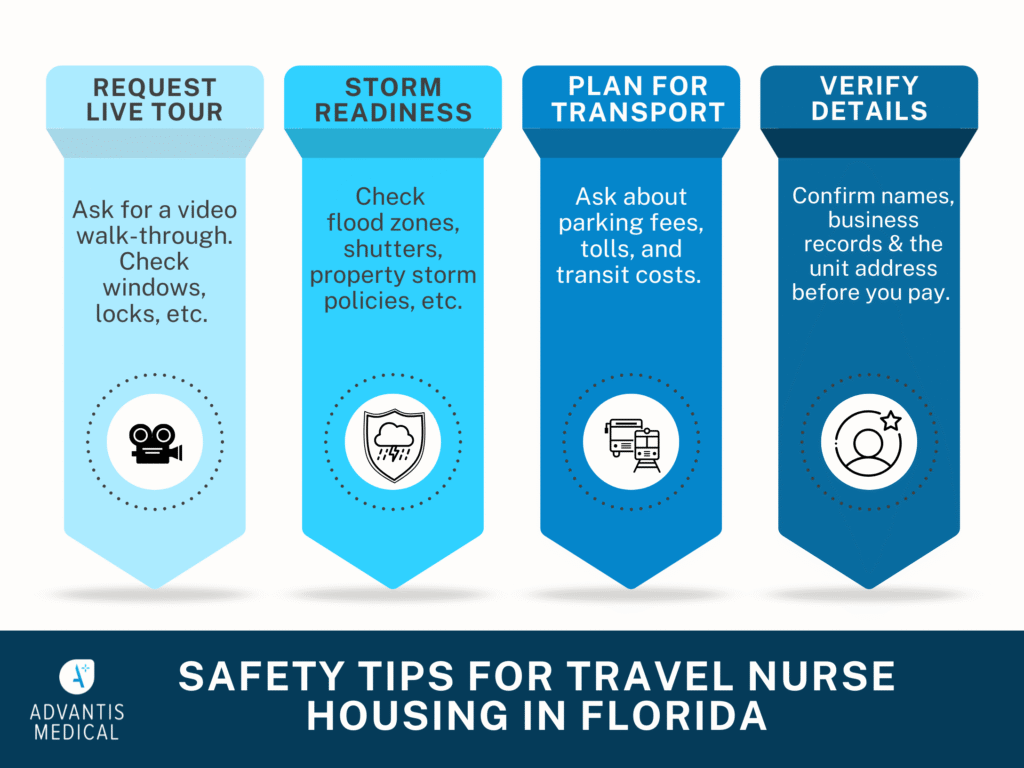
Use the graphic below as a quick first pass: tour the actual unit, check storm readiness, plan the commute, and verify the property and payment details. Then use the five checks below before money changes hands.
Verify before you pay
- Confirm the owner’s or property manager’s legal name, the exact address, and their authority to rent the unit.
- Ask for a live video walkthrough of the specific unit. Check doors, windows, locks, air conditioning, laundry, parking, noise, and anything else that matters to your day-to-day routine.
- Match the lease to your assignment dates and review the deposit, fees, cancellation policy, extension terms, utilities, pet and guest rules, and move-out requirements.
- Confirm the payment method directly with the landlord or property manager before sending money. Keep a written record of the instructions, and avoid wire transfers or other unsecured payment methods.
- If you’re sharing the space, agree on sleep schedules, guests, pets, cleaning, temperature, kitchen use, and shared expenses before move-in.
A good plan for travel nurse housing in Florida isn’t simply about finding the lowest monthly rent. The rental should fit your contract dates, commute, budget, shift, and comfort level with the lease. Once you’ve narrowed down a few areas, compare current travel nurse jobs in Florida by specialty, pay, shift, and location, then look at the housing options alongside the full assignment package.
FAQs for Travel Nurse Housing in Florida
How do travel nurses find short-term rentals in Florida?
Most nurses look for housing through Furnished Finder, Airbnb, or agency lists. Some also find housing through other nurses in social groups.
How do housing stipends work for travel nurses in Florida?
Travel nurses who have a tax home will receive tax-free stipends for duplicate housing costs while on assignment. If your rent is lower than the stipend, you may keep the difference.
What hurricane factors should travel nurses consider in Florida?
Check if the building has shutters, clear storm rules, and renter’s cover. Ask about evacuation paths before signing.
Will my travel nursing agency provide housing support in Florida?
Yes, many agencies like Advantis Medical offer concierge-style housing support, helping nurses find and book affordable, safe housing that fits their stipend.
What types of travel nurse housing are available in Florida?
Travel nurses can choose from extended stay hotels, furnished apartments, condos, townhouses, or rental homes depending on assignment length and budget. There are many exciting traveling nurses housing in Florida.


