

Ultimate Guide to Physical Therapy Licensing and the PT Compact (2026)


In this article
- What Is the PT Compact?
- 6 Benefits of the PT Compact License for Physical Therapists
- PT Compact State Overview
- Physical Therapy Compact License: Eligibility Requirements
- How to Apply for a PT Compact Privilege
- What If You Want to Work in a Non-Compact State?
- What Is the Cost of PT Licensing?
- Compact State Snapshots (2026)
- Helpful Resources and Licensing Tools
- Why the Physical Therapy Compact License Matters for Travel Therapists
- Ready to Launch Your Compact PT Career?
Starting a career as a travel physical therapist opens the door to flexibility, higher earning potential, and the chance to explore the country. But before you can start traveling, it’s important to understand how licensing works, especially if you want to practice in multiple states.
That’s where the PT Compact license comes in. This growing interstate agreement makes it easier for PTs and PTAs to get a physical therapy compact license and easily work between participating states.
In this 2026 guide, you’ll find everything you need to know about PT Compact states, eligibility, fees, application steps, and tips for making your travel PT journey faster and more efficient.
What Is the PT Compact?
The Physical Therapy Compact represents an interstate agreement between participating jurisdictions that allows licensed PTs and PTAs to practice across state lines through a streamlined compact privilege system.
This privilege system operates through verification of the practitioner’s home state license and compliance with both the home state’s and the remote state’s requirements.
6 Benefits of the PT Compact License for Physical Therapists
The Physical Therapy Compact license has a lot of perks for therapists seeking career flexibility and expanded practice opportunities.
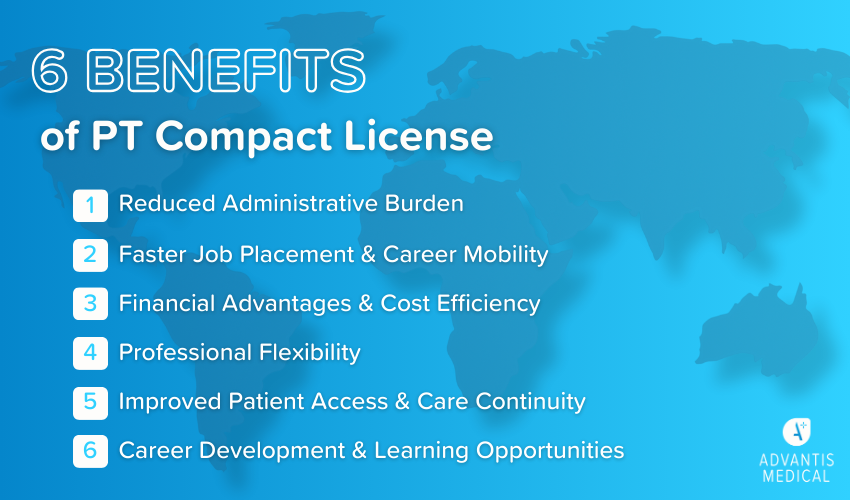
Reduced Administrative Burden
Traditional licensing requires separate applications, fees, background checks, and documents for each state where a therapist hopes to practice. The PT Compact streamlines this by letting PTs practice in multiple states through a centralized system —reducing paperwork and administrative complexity.
Faster Job Placement and Career Mobility
Travel therapists with a PT Compact license often begin working much faster than those navigating traditional licensing. The compact privilege process typically moves far faster than the months required for individual state licensing—so you can respond quickly to urgent staffing needs and accept the assignments you want before they’re filled.
Financial Advantages and Cost Efficiency
Compact privileges may involve per-state fees, but they’re often more affordable than repeating full licensure. You also reduce duplication (e.g., repeated background checks) across physical therapy compact states, cut document handling, and avoid multiple full-license renewals. For clinicians near borders or taking short-term, multi-state contracts, these savings add up.
Professional Flexibility
The PT compact license gives you more location choices. You can enter new markets without waiting for lengthy license approvals, tap into different clinical experiences, and maintain a work-life balance. The ability to pivot quickly also offers security when local demand shifts.
Improved Patient Access and Care Continuity
The PT Compact helps PTs move where support is needed—during natural disasters, seasonal surges, or staffing shortages—improving access and outcomes, especially in rural or remote communities.
Career Development and Learning Opportunities
Working across multiple states through compact privileges exposes you to diverse clinical practices, patients, and healthcare systems. You’ll expand clinical range and cultural competence while building a stronger resume.
PT Compact State Overview
State participation status directly impacts where you can get compact privileges and practice without traditional licensing requirements.
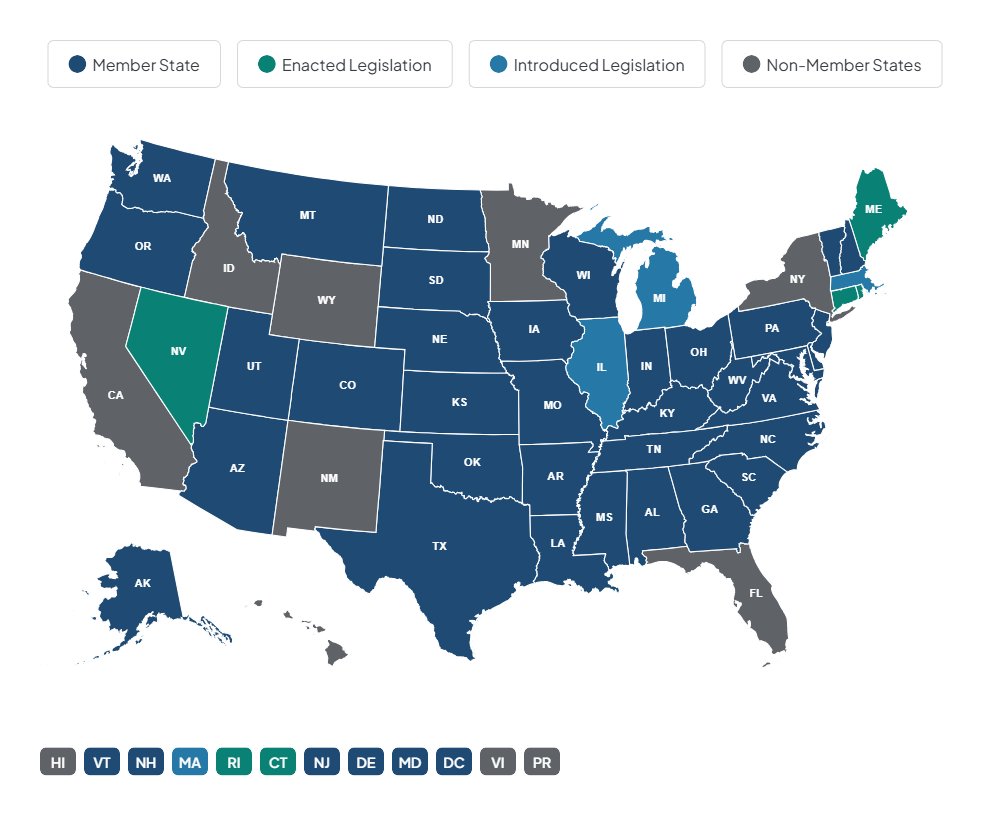
States Currently Issuing Privileges
As of 2026, more than 30 states (and D.C.) actively issue and accept PT Compact privileges, with others in the implementation phase.
PT Compact Member States:
- Alabama
- Alaska
- Arizona
- Arkansas
- Colorado
- Delaware
- District of Columbia
- Georgia
- Indiana
- Iowa
- Kansas
- Kentucky
- Louisiana
- Maryland
- Mississippi
- Missouri
- Montana
- Nebraska
- New Hampshire
- New Jersey
- North Carolina
- North Dakota
- Ohio
- Oklahoma
- Oregon
- Pennsylvania
- South Carolina
- South Dakota
- Tennessee
- Texas
- Utah
- Vermont
- Virginia
- Washington
- West Virginia
- Wisconsin
Non-Participating States
States that haven’t adopted PT Compact legislation still rely on traditional licensing. Some have proposed compact bills, hinting at future involvement. If you plan to practice in a non-participating state, pursue that state’s traditional license—each board has unique requirements, fees, and processing times.
Physical Therapy Compact License: Eligibility Requirements
Meeting PT Compact eligibility requirements is the first step toward earning privileges to practice in multiple states.
Active Home-State License Requirement
You must hold a current, active, unencumbered PT or PTA license in a compact member state that serves as your primary residence. This home license must remain in good standing throughout any compact privileges. The home state is determined by permanent residence and typically verified via a driver’s license.
Note: Temporary permits, temporary licenses, or temporary authorization do not qualify for compact eligibility. Only full, permanent licenses from compact-member states meet the requirement.
Clean Disciplinary Record
Applicants can’t have active disciplinary actions on their licenses, whether in their home state or elsewhere. Minor past violations may not disqualify you, but open investigations will prevent approval.
Home-State Compliance
You must meet all continuing-education, renewal, and professional standards established by your home state (including liability insurance where required). Home-state boards retain primary oversight of compact-privilege holders and can take action affecting both your home license and privileges.
FBI Background Check
Applicants for compact privileges must complete FBI criminal background checks where required. Processes vary by state but often include fingerprinting and a review of criminal history.
Jurisprudence Examination Compliance
Several states require jurisprudence exams testing knowledge of local laws and rules. These confirm you can practice safely under each state’s standards.
6,000+ live contracts nationwide, each showing exact weekly pay, shift, and start date. Updated today.
How to Apply for a PT Compact Privilege
Earning compact privileges is done online. Follow the steps below to move quickly and accurately.
Step 1: Verify Eligibility
Confirm your home state and intended practice states are active PT Compact members. Review eligibility requirements (license status, residence, discipline history) to confirm you qualify. Use the official PT Compact site to verify current participating states and check for recent changes.
Step 2: Organize Your Paperwork
Have these ready:
- Current home-state PT/PTA license verification
- Valid driver’s license confirming home-state residency
- Professional liability insurance (if required by a remote state)
- Completed jurisprudence exam certificates (if required by a remote state)
- Payment method for privilege and commission fees
Step 3: Complete the Online Application
Use the PT Compact portal’s secure flow:
- Enter your FSBPT ID and password to access your dashboard
- In your dashboard, click PURCHASE and choose the states you need privileges for
- Pay all fees
- Receive your compact privilege number(s)
Accuracy matters: Providing incorrect or incomplete information can lead to denial or delays.
Step 4: Pay Required Fees
Compact privilege fees vary by state. You’ll typically pay a commission fee plus a state-specific fee per privilege. Some states charge separate jurisprudence or processing fees.
Step 5: Complete State-Specific Requirements
Some remote states require additional steps prior to activation.
Common examples:
- Jurisprudence exam completion and passing scores
- Additional background check
- Professional liability insurance proof
- Notification of practice location within the remote state
Application Processing Timeline (2026)
Most compact privileges are processed quickly—often within one business day once all requirements are completed. However, allow up to 30 business days for states that require additional verification or jurisprudence completion.
Renewal and Maintenance
Compact privileges generally align with your home-state license renewal cycle. Maintain your home license and CE requirements to keep privileges active.
For step-by-step assistance and current fee schedules, visit the PT Compact website for detailed guides and support resources.
What If You Want to Work in a Non-Compact State?
If you plan to work in a state that isn’t part of the compact, you’ll need to follow that state’s traditional licensing by endorsement process. It takes more time and paperwork than compact privileges, so plan ahead.
Research State-Specific Requirements
State PT boards publish detailed instructions on:
- CE requirements for maintenance
- Endorsement pathways for licensees from other states
- Temporary or provisional licensing options
- Special requirements for internationally educated practitioners
Application Timeline Planning
Licensing by endorsement typically requires 4–12 weeks for complete processing. To move faster:
- Apply online and complete every field accurately
- Upload clean, legible documents
- Follow up on application status
- Don’t wait until the last minute
- Work with your recruiter to expedite paperwork
License Verification and Endorsement
Many states offer endorsement pathways for practitioners already licensed elsewhere. Endorsement applications often require:
- Verification of current license status from other states
- Proof of CE compliance
- Criminal background check completion
- Payment of endorsement fees
Some boards use centralized verification services to simplify this step when you hold multiple licenses.
What Is the Cost of PT Licensing?
Traditional licensing fees vary widely by state (commonly $100–$400), plus:
- Background check and fingerprinting fees
- Jurisprudence exam fees
- License verification fees from other states
- Expedited processing fees (when available)
For up-to-date information, visit the state’s official PT board sites.


Compact State Snapshots (2026)
What are each state’s licensing requirements? Here’s an overview of several popular states for travel PT jobs.

Arizona
Compact Status: Active PT Compact member issuing and accepting privileges
Jurisprudence Requirement: Yes — Arizona Law (AZLAW) exam required
Compact Application Fees:
- State CP Fee: $85
- Commission CP Fee: $45
Texas
Compact Status: Active PT Compact member issuing and accepting privileges
Jurisprudence Requirement: Yes — Texas jurisprudence exam is required for both traditional licenses and compact privileges
Compact Application Fees:
- State CP Fee: $50
- Commission CP Fee: $45

South Carolina
Compact Status: Active PT Compact member issuing and accepting privileges
Jurisprudence Requirement: No — SC does not require a jurisprudence exam for compact privileges
Compact Application Fees:
- State CP Fee: $0
- Commission CP Fee: $45

North Carolina
Compact Status: Active PT Compact member issuing and accepting privileges
Jurisprudence Requirement: Yes — NC jurisprudence exam required within 30 days of compact-privilege purchase
Compact Fees:
- State CP Fee: $100
- Commission CP Fee: $45

Hawaii
Compact Status: Non-compact — Licensing by endorsement required
Jurisprudence Requirement: Yes — Hawaii-specific jurisprudence exam
Notes: Hawaii has not enacted PT Compact legislation. Traditional licensure is required. Endorsement is available for those licensed elsewhere, with strict documentation.

Alaska
Compact Status: PT Compact member issuing compact privileges
Jurisprudence Requirement: No — no state jurisprudence exam for compact privileges
Compact Application Fees:
- State CP Fee (PT): $200
- State CP Fee (PTA): $130
- Commission CP Fee: $45

Washington
Compact Status: Active PT Compact member issuing and accepting privileges
Jurisprudence Requirement: Yes — Washington jurisprudence exam required
Compact Application Fees:
- State CP Fee: $47 (listed as $45 + $2 processing)
- Commission CP Fee: $45
Helpful Resources and Licensing Tools
Official PT Compact Site
The PT Compact site provides official information, applications, and updates. You can request compact privileges through a secure portal, review eligibility, and confirm fee schedules. The commission also publishes rule updates impacting privilege holders.
Federation of State Boards of Physical Therapy (FSBPT)
FSBPT manages the NPTE, score services, license verification, and CE resources. Their mission is public protection through safe, consistent PT practice.
American Physical Therapy Association (APTA)
APTA offers a directory of state licensure boards, CE and career resources, and advocacy updates. They help therapists solve licensing challenges and practice across state lines.
State Licensing Board Resources
State PT boards provide online application systems, CE tracking, renewal timelines, and public disciplinary records. Check your state board’s site for updates affecting licensure and renewal.
Why the Physical Therapy Compact License Matters for Travel Therapists
The PT Compact makes travel therapy easier, faster, and far more flexible. For PTs and PTAs who want to take assignments nationwide, the compact removes many of the licensing barriers that traditionally slow down travel careers. Here are the key reasons the PT Compact matters for travelers today.
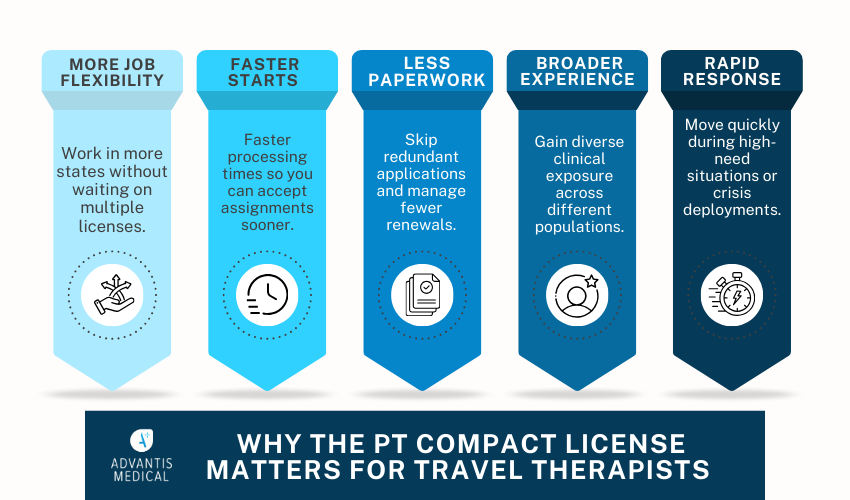
Career Flexibility and Opportunity Expansion
The PT compact simplifies licensing, helping you find jobs faster. Facilities fill staffing needs sooner, and therapists can secure roles in settings that match their goals—without waiting on multiple state licenses.
Faster Placement and Revenue Generation
Traditional licensing can delay assignments 6–12 weeks, creating income gaps. PT Compact privileges are processed quickly, enabling faster starts and more completed assignments—often unlocking premium-rate opportunities.
Less Paperwork
Managing multiple licenses is a burden. The PT compact license consolidates steps and cuts duplication, so you spend less time on admin and more time treating patients and developing skills.
Professional Development and Clinical Diversity
Practicing in various states broadens your exposure to health systems and patient populations, improving adaptability and clinical judgment—skills that elevate outcomes and career prospects.
Flexibility and Quick Crisis Support
The compact helps route PTs to where they’re needed during emergencies, disasters, or sudden demand spikes—improving access and continuity for patients.
Ready to Launch Your Compact PT Career?
You’ve earned your license—now put it to work across state lines.
How Advantis Medical helps PTs & PTAs:
- One-on-one eligibility verification and compact strategy
- Access to exclusive, high-pay assignments across physical therapy compact states
- Faster starts with a credentialing and compliance team that keeps you on schedule
Explore high-paying Physical Therapy jobs at Advantis Medical and start your next assignment with confidence.


